
Your movement and your life can also become an easy happening that follows the wind and the currents.
— Tai Chi Master Al Huang
Tai Chi will awaken your life force – chi energy – and harmonize your body, mind and spirit. It is a metaphor for life, a way of expressing your inner self, of coming back to your center, calming the clatter of your life.
Tai Chi is an ancient, healing movement meditation, originating in China 4,000 years ago. The individual postures of Tai Chi are based on movements seen in nature, such as those of water, birds, wind and flowers. A Tai Chi session consists of a slow, graceful sequence of movements, done while standing, which explore expansion, contraction and balance.
Cynthia teaches a form of Tai Chi which encourages one’s own unique expression and experience of the Tai Chi form. Cynthia began studying Tai Chi after experiencing a back injury. Tai Chi has played a crucial role in her personal healing journey. Cynthia says: “Now I offer my teachings to you because Tai Chi has been a doorway of healing for me.”
Cynthia’s classes include energizing warm-ups, Tai Chi practice and a guided deep relaxation. The practice of Tai Chi helps one to put aside the worries and stresses of daily life, “smell the roses,” and find serenity by resting in the present moment.
Cynthia’s Advanced T’ai Chi Training with Chungliang Al Huang: 1982–Present.
- Molokai, Hawaii
- Taos, NM
- Urbana, IL
- Boston, MA
- Gold Beach, OR
- San Feliu, Spain
- Lanting Institute, China
Benefits of Tai Chi
- Improves cardiorespiratory function and lowers blood pressure, especially for persons recovering from heart attacks and cardio-bypass surgery
- Improves range of motion, flexibility, strength and balance; decreases risk of falls in seniors
- Shifts focus off area of pain into a relaxed state
- Creates active relaxation
- Helps release feelings of anger, depression and grief
- Complements conventional medical treatments for chronic pain, fibromyalgia, MS and chronic fatigue syndrome
- Enhances vitality and brings a sense of well-being and peace
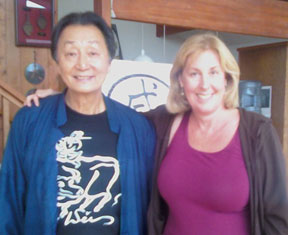
Tai Chi is an ancient, healing movement meditation, originating in China 4,000 years ago. The individual postures of Tai Chi are based on movements seen in nature, such as those of water, birds, wind and flowers. A Tai Chi session consists of a slow, graceful sequence of movements, done while standing, which explore expansion, contraction and balance.
Cynthia teaches a form of Tai Chi which encourages one’s own unique expression and experience of the Tai Chi form. Cynthia began studying Tai Chi after experiencing a back injury. Tai Chi has played a crucial role in her personal healing journey. Cynthia says: “Now I offer my teachings to you because Tai Chi has been a doorway of healing for me.”
Cynthia’s classes include energizing warm-ups (Qi Gong), Tai Chi practice and a guided deep relaxation. The practice of Tai Chi helps one to put aside the worries and stresses of daily life, “smell the roses,” and find serenity by resting in the present moment.
Learn more about Tai Chi
Cynthia’s Clients Say:
One morning I was practicing my Tai Chi as usual. I was doing the First Circle. Just as I lifted my foot in order to step over tiger, my orange and white tabby leaped directly into that space which required me to step over him. Although he was not sleeping, stepping over tiger had more meaning for me on that special morning.
– Cricket Babajian, Tai Chi Student
My introduction to Tai Chi was in Cynthia Ghiron’s Tai Chi classes at the YMCA in Boulder. I found the class to be the highlight of my week, with soothing music, beautiful imagery, flowing movements and a fun atmosphere. I recently tried a Tai Chi class nearer my house and found it to be not half as enjoyable as Cynthia’s class. The other class was a lot of time spent standing around and talking about fighting, history etc with no music. Because I’m looking for a spiritually uplifting mind-body experience, I signed up for Cynthia’s class again.
— Joan Gregerson, Longmont, CO
About 6 years ago I learned I had heart disease. I improved my nutrition and exercise easily enough but I wasn’t sure how to reduce stress, a major cause of heart disease. I began Tai Chi at that time and have continued ever since. I have a noticeable drop in blood pressure and I feel so much more centered after I perform Tai Chi. I highly recommend it.
— Paul Malinowski, Littleton, CO
Cynthia Ghiron guides her students through a meditative movement experience. I personally had the opportunity to study Tai Chi with her over a four year period. I found a peace of mind, equanimity and centeredness that greatly contributed to my well being and ability to cope with the stresses of everyday life. I highly recommend Cynthia’s approach to teaching Tai Chi – she is a kind, supportive and encouraging teaacher – a pleasure to learn from.
— Lynn Pfeffer
In my work as an ultra-sonographer I had developed pain due to chronic repetitive motion. The simple and gentle rotation and stretching of the shoulders along with the movements and focused breathing of Tai Chi has both decreased my pain and helped me to feel the calmness within. I am grateful to Cynthia for providing me with such a wonderful experience.
— Norma Drury
In my fifteen years of Tai Chi class with Cynthia Ghiron, Tai Chi has been both play and meditation. No matter how hectic my day, how sore my body, how sad my heart, Tai Chi in the company of others expands my energy and turns me towards my better and stronger self.
— Mary Alice Parmalee
I had wanted to learn Tai Chi for some years before I found the opportunity provided by Cynthia Ghiron’s fine teaching. Here was something that it would be possible to do until older age, but was (as I discovered) something that also improved the quality of life as I got older. Tai Chi teaches you to breathe, how to stay limber, helps with balance, and eases muscle and joint aches. I talso allows you the pleasure of moving gracefully. It is something that I do anywhere in a spare moment during the day – stretching to break up sedentary hours at the computer, and before and after a workout at the gym. You can teach pieces of it to colleagues and family members and enjoy a break together. In short, I recommend Tai Chi to anyone who wants to move more gracefully and easily into older age. Cynthia Ghiron’s teaching is also excellent. She is thoughtful, skilled, encouraging and leaves no one behind.
— Elaine Seymour
I wanted to express my gratitude for Cynthia’s Tai Chi instruction in the past few years. I enrolled primarily because of its beauty and controlled movement aspects. Although I did not believe much in Tai Chi’s health benefits at first, I have found it prevents my recurrent back and neck aches that I experience as a result of my work as an optometrist. I also appreciate your relaxation and meditation sessions. I find they help me relax from stress.
— Daniel C. Weber, O.D.
Tai Chi has offered me the opportunity to gain a new way of being insightful, both to myself and others. It has given me inner peace.
— Deb Wolf
This class is what we need more of today, in this age of seeking to pull together and rebalance ourselves and the world. Tai Chi has given me another tool for self-healing and healing of others. Excellent.
— Chris Hazelton
This course offers a gentle contemplative approach to a physical expression of being alive.
— Ken Robinson
There is so much energy to harness in the universe. Tai Ji makes me feel more connected to the world.
– Catriona Mize

